
Why Speed is the New Moat: 5 Hard Truths About Building Products in the AI Era
Most products fail from confidence, not incompetence. The market for slow, expensive validation is gone. Here's what building in the AI era actually demands.
Prodomark Team
28 June 2026

The expensive way to learn you were wrong
I've sat across from a lot of founders over the years. The pattern that breaks my heart most goes like this: someone spends nine months and a six-figure budget in stealth mode, polishing features and arguing about button colors, then launches to a room that's empty. Nobody shows up. Not because the engineering was bad. Usually the engineering is fine. They just spent all that money answering a question nobody asked.
The old playbook was build first, ask later. That made sense when shipping software was slow and expensive and you only got a few shots. It doesn't make sense anymore. Most companies don't die from a lack of talent or ideas. They die from confidence: they were sure they had the answer before they'd really checked the question.
That's the whole point of the lean approach. A startup isn't a tiny version of a big company. It's a temporary thing whose only job is to find a business model that actually works and can grow. And right now, with the technical barriers dropping every month and competitors able to copy your features over a weekend, the company that learns fastest wins. Speed isn't a vanity metric. It's the moat.
One reframe that saves people a lot of money: don't try to be first to market. Try to be first to learn what the market wants.
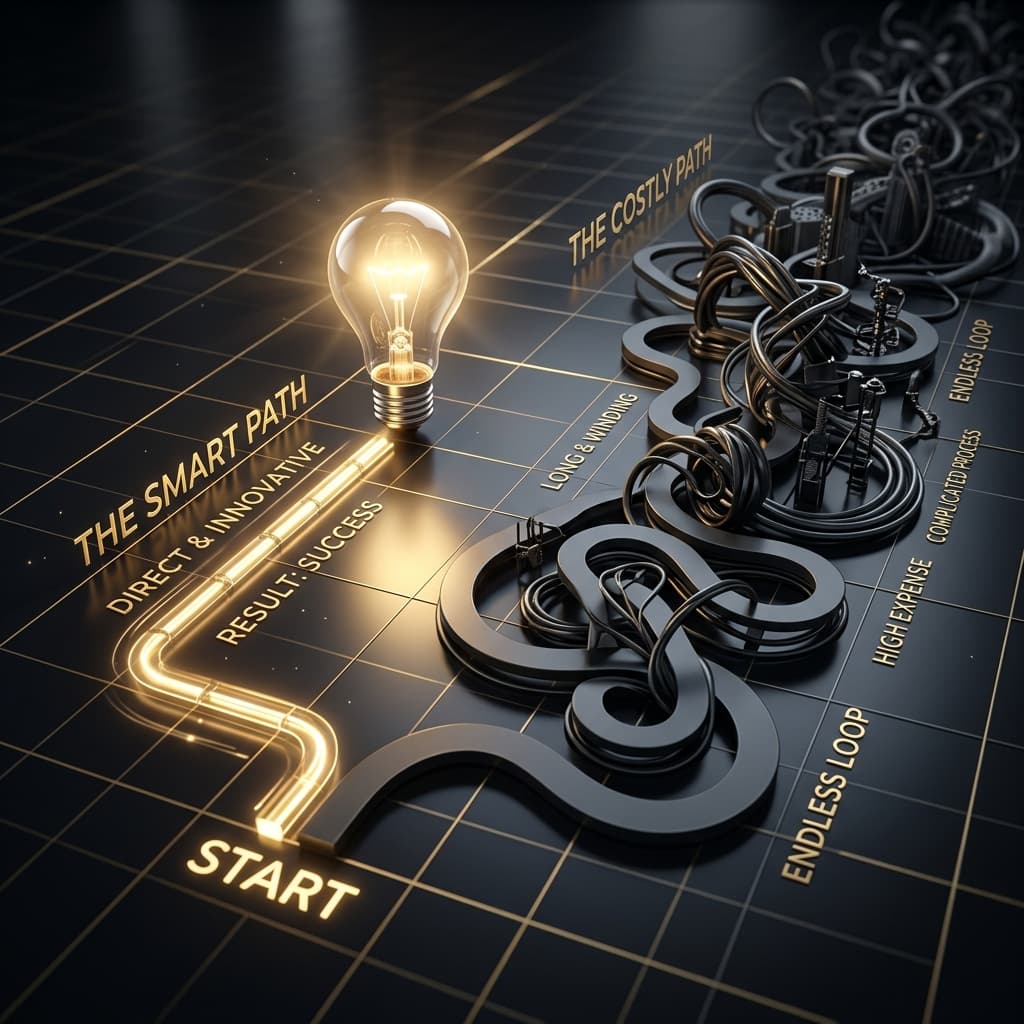
1. An MVP is not a cheaper version of your product
This one trips up almost everyone. People hear 'minimum viable product' and picture a stripped-down, buggy version of the real thing. That's not what it is. An MVP isn't a product at all. It's an experiment.
If you're thinking about which features to cut, you're still thinking like you're building the final thing. The actual goal is to learn as much as you can about your customers while spending as little as possible to do it.
It helps to keep these straight, because people use them interchangeably and then talk past each other:
| Concept | What it is | What it's for | What you hand over |
|---|---|---|---|
| Wireframe | A rough blueprint of the screens | Test flow and layout | Sketches or low-fi layouts |
| Prototype | A clickable mockup | Test design and interactions | A Figma or Adobe XD link |
| Proof of Concept | A test of one technical question | Prove something can be built | A script or API test |
| MVP | The smallest thing that solves the core problem | Test whether anyone wants it | A live, working version of the one feature that matters |
| Production Product | The full, scaled build | Grow the business | Scalable software |
The two words both matter. Minimum means don't overbuild. Viable means it has to actually solve the user's problem. Build something minimal that solves nothing and you've got a prototype. Build something that solves the problem but takes a year, and whatever that is, it isn't an MVP.
2. The validation window went from months to weeks
A few years ago, sitting down with 50 hours of customer interviews and pulling out the real patterns was a multi-week job for a small team. Now you feed those transcripts to a decent model and get back the pain points, the sentiment, and the feature requests in the time it takes to make coffee.
Same story on the build side. A good senior engineer with AI tooling now ships in a few weeks what used to take a few months. A real, working MVP in four to six weeks is normal, not impressive.
So the excuse for moving slowly is gone. If your plan is to spend six months heads-down before you talk to the market, you're working on yesterday's clock. The tools let you write decent early copy without waiting on a copywriter, watch how your first users actually behave instead of guessing, and change things the same week you learn them.
Here's the test: if you can't get something in front of a real user inside 30 days, either your scope is bloated or your technical partner is doing it the old way.
3. The feature trap still kills more startups than anything else
You'd think faster building would fix this. It makes it worse. When features are cheap to add, 'let's just add one more' becomes irresistible. The chatbot, the dashboard with twenty charts, the social feed nobody asked for. Every one of those you ship before you've validated is a liability. More to maintain, more to confuse the user, and it waters down the one thing you're actually good at.
The mistakes I see over and over:
- Building for everyone: Trying to win the whole market instead of nailing one problem for one specific group
- Skipping customer interviews: Trusting your gut when real data is a few conversations away
- Waving off bad feedback: When users say it's confusing, deciding they're just 'not the target'
- Picking shiny over scalable: Stacks that look great in a blog post and are a nightmare to maintain
- Hiring order-takers: Developers who build exactly what you asked for, even when what you asked for is a bad business call
A no-code tool or an AI wrapper is only as good as the thinking behind it. If the strategy's wrong, all the AI does is help you build the wrong thing faster.
4. AI can code. It can't think.
Here's the part people don't want to hear. AI is an incredible accelerator and a terrible strategist. It'll write you a script or a landing page in seconds. It will not tell you why your customers really buy, how to get through a messy B2B enterprise sale, or how to build something competitors can't just clone next quarter.
That gap is exactly where experienced people still matter, and matter more than before. As coding gets easier, the edge stops being who can build it and becomes who knows what to build.
The things a good human partner brings that a model won't:
- 1Discovery: The uncomfortable conversations that get you down to the one problem worth solving
- 2Architecture and security: AI-generated code tends to ignore what happens at 10,000 users — someone has to make sure you're not rewriting the whole thing in a year
- 3User journeys: Understanding how a real person actually moves through your product, logically and emotionally
- 4Knowing where AI helps: Spotting where it adds real value versus where it's just a gimmick bolted on

5. Every giant started embarrassingly small
Founders love to point at Amazon or Facebook and say they need all of it to compete. They forget where those companies started.
- Amazon sold books. Just books. Bezos drove the packages to the post office himself.
- Facebook was a directory for Harvard students. No feed, no marketplace, none of it.
- Airbnb was air mattresses on a floor during a conference when the hotels were full.
- Dropbox didn't even build the product first. They made a video to see if anyone would sign up.
- Uber was 'UberCab,' black cars in one city, ordered by text.
The blueprint is the same every time: solve one problem for one person, then grow.
| Traditional launch | Lean launch | |
|---|---|---|
| Goal | Finish all the features | Learn what's true |
| Cost | $100k–$500k+ | Low four-to-five figures |
| Time to market | 6–12 months | 4–6 weeks |
| Risk | High — market may say no | Low — pivot early |
| Feedback | After launch | During discovery |
Where Prodomark fits
We don't just 'build apps.' Prodomark is an AI-powered product innovation studio. We help founders and teams validate the idea, design it, build the MVP, and get it to market using AI-assisted workflows — at startup speed. One team instead of three. Validation first. Idea to market.
Most products fail because they get built before anyone checks whether they should exist. The thing missing usually isn't talent — it's a system that validates before it builds. That's what we put in place.
- Product Discovery: validate before you build — idea validation, market research, competitive analysis, strategy, and a roadmap grounded in evidence
- Product Design: UX research, journey mapping, wireframes, UI, and a full design system ready to hand to engineering
- Product Development: production-ready MVPs, SaaS, and mobile apps in four to six weeks, AI-assisted
- Product Growth: analytics, conversion optimisation, and experiments to turn users into revenue
Full IP ownership transfers to you on delivery. No lock-in.
How an engagement runs
Same six steps every time, because building the wrong thing quickly is still building the wrong thing.
- 1Idea: get clear on the problem, the user, and the bet you're making
- 2Validate: test demand before writing code — interviews, landing pages, market analysis
- 3Design: research, journey maps, wireframes, UI, and the design system
- 4Build: MVP engineering with weekly demos and production-ready code, on schedule
- 5Launch: ship with a real go-to-market plan — positioning, messaging, channels, first users
- 6Grow: analytics and experiments that compound over time
Idea to MVP in four to six weeks. Roughly four times faster than the usual pace.
Before you build: eight questions
Run through these before you spend a dollar on development.
- 1Is there a real, painful problem for a specific group of people?
- 2Have you talked to at least 10 potential customers who aren't friends or family?
- 3What's the one feature that, if you removed it, makes the whole thing pointless? That's your MVP.
- 4Do you know exactly how you'll measure success — a sign-up number, a retention rate, something concrete?
- 5What are the three biggest assumptions you're making about your users?
- 6Could you test those with a landing page or a manual workaround first?
- 7What's your plan if 1,000 people sign up tomorrow?
- 8Does your dev partner understand the business, or are they just taking a feature list?
FAQ
The takeaway
The advantage doesn't go to whoever writes the most code anymore. It goes to whoever figures out what's true the fastest. The technical walls are down. The thing standing between you and a product people actually want is your willingness to test, learn, and adjust.
AI isn't a magic wand. It's fuel. You still need someone who knows where they're going and a real map. Solo founder or corporate team, the job is the same: find product-market fit before you run out of money.
So be honest with yourself. Is your roadmap building something the market wants, or are you just coding toward a wall you can't see yet?
Ready to build your product?
Book a free Discovery Session — no commitment, no sales pitch.
Book a SessionRead Next
Validate Before You Build: Why Discovery Saves You Months of Wasted Work
Most failed products weren't poorly built — they were built for problems nobody actually had. Here's why a 5-day discovery sprint is the highest-ROI investment you can make.
The MVP Trap: Why Most Startups Build the Wrong First Version
An MVP isn't the smallest thing you can build — it's the right thing to learn from. Understanding this distinction is the difference between a product that ships and one that scales.